
Managing Urban Heat Using Nature-Based Solutions
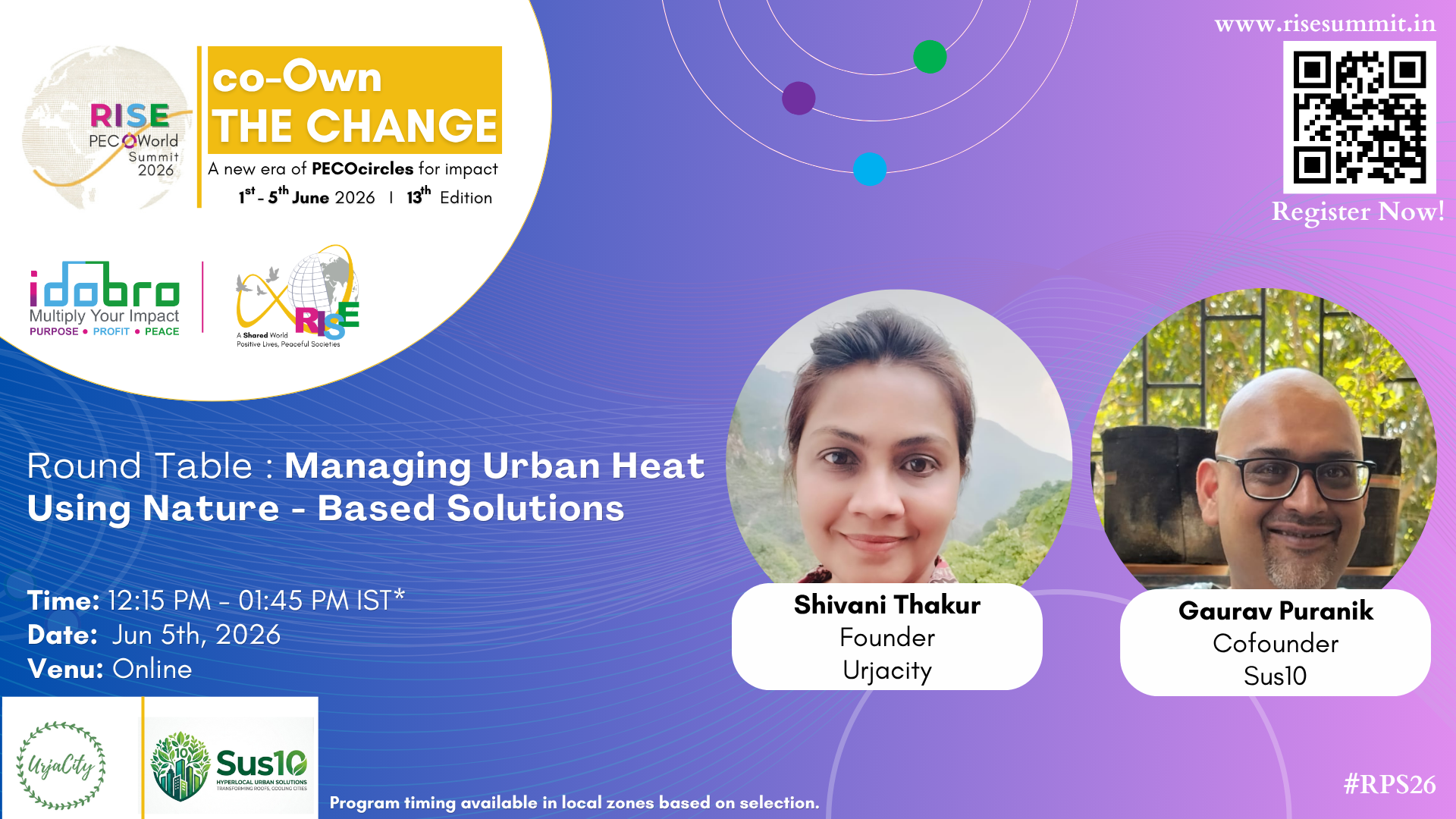
Rapid urbanization has converted our cities into literal thermal traps. In this roundtable panel held on 5th June from the RISE PECOWorld Summit 2026, climate tech experts, policy advocates, and infrastructure innovators argue that heavy reliance on artificial, energy-intensive air conditioning is unsustainable. The session's core thesis: mitigating the severe urban heat island effect requires a strategic shift toward Nature-Based Solutions (NbS), utilizing localized water systems, digital monitoring, and decentralized, community-driven rooftop transformations under the summit's central vision, "Co-Own The Change". “Technology alone is a weak shield against climate risk. True urban cooling requires multi-solving—where a single intervention simultaneously addresses heat mitigation, local food security, and collective civic action.” The Thermal Trap: Moving Beyond Artificial Cooling Modern concrete jungles absorb and re-radiate solar heat, creating highly concentrated urban microclimates where temperatures can soar significantly higher than adjacent rural areas. Roundtable leaders Shivani Thakur (Founder, Urjacity) and Gaurav Puranik (Co-Founder, Sus10) highlight that continuing to fight this thermal accumulation with air conditioning only creates a vicious feedback loop, dumping waste heat back into our streets. To cool cities effectively, urban planning must prioritize nature-first ecosystem designs. By integrating vertical micro-forests, high-reflectivity materials, and natural wind and water corridors, municipalities can actively reduce ambient air temperatures without draining the power grid. Actionable Pathways for Cooling Concrete Jungles 1. Decentralized Rooftop Transformation A vast portion of a city’s thermal mass is concentrated in bare, dark roofs. Pratik Tiwari (Living Greens) points to a massive, underutilized opportunity: converting these barren, concrete slabs into organic farms. Greening roofs shields building envelopes from direct solar exposure, reducing indoor temperatures while addressing food toxicity. However, a critical bottleneck remains. Tiwari notes that while agricultural ministries understand the value of urban farming, urban housing and municipal ministries lack the policy frameworks to support and incentivize large-scale rooftop transitions. 2. Data-Driven Mapping for Micro-Scale Planning Awareness is only half the battle; scaling green infrastructure requires precise data. Gaurav Puranik (Sus10) demonstrated mapping technology that identifies unmapped, bare rooftops in dense hubs like Bangalore. By quantifying exactly how much solar exposure and greening potential a neighborhood possesses, this digital tool removes administrative guesswork, providing housing societies and micro-enterprises with a clear, data-backed roadmap to transition. 3. Restoring Water as an Ecosystem Service Provider Traditional civil engineering treats urban lakes, ponds, and canals purely as passive flood-retention basins or drinking water storage. Madukar Sanbu (Vadik Region) advocates for a profound paradigm shift: treating water bodies as dynamic ecosystem service providers. Restoring urban wetlands, clearing encroached floodplains, and revitalizing natural channels introduces systemic evaporative cooling. This process not only drops localized air temperatures but also purifies ambient air, improves soil health, and fosters regional biodiversity. 4. Financial Viability and Digital Verification Nature-based infrastructure often struggles to secure long-term capital because its cooling and carbon-sequestration benefits have historically been hard to measure. Dhwani (Ploxxy) highlights how Digital Measurement, Reporting, and Verification (DMRV) technology is closing this gap. By utilizing real-time sensor networks and satellite imaging, projects can verify environmental outcomes in real-time, packaging them as credible carbon credits to attract industrial ESG investment. Strategic Framework: The PECO World Approach to Multi-Solving Rather than waiting for slow, top-down bureaucratic mandates, the panel introduced structural frameworks designed to empower grassroots networks to act immediately: Systemic Risk Lensing: Sarabjit Singh suggests applying a proactive risk-mapping approach to urban planning, particularly in highly dense, under-resourced settlements like slums. This ensures that cooling interventions are directed to the most vulnerable communities before extreme heatwaves hit, rather than reacting afterwards. The PECO-Net Architecture: Instead of top-down municipal oversight, the RISE PECOWorld platform uses its collaborative platform, PECO-Net, to build decentralized "circles" or hyper-local action missions. This allows residential housing societies, local schools, and micro-enterprises to directly share templates, swap resources, and implement interventions together. Targeted Grassroots Campaigns: The roundtable concluded with a call to launch concrete, localized campaigns through these circles—setting targeted missions like "1,000 Green Rooftops in Jaipur" or a coordinated community restoration of natural water bodies across the Delhi NCR region. Conclusion: Designing Living Cities Mitigating rising urban temperatures requires us to stop viewing nature as a luxury ornament and start treating it as essential public infrastructure. When local enterprises, housing collectives, and environmental innovators co-own the transition, concrete surfaces can be turned back into living, breathing sponges. The future of our cities rests on a simple premise: we must either co-design with nature, or continue to burn in the traps we built. FAQ What is the urban heat island (UHI) effect, and how do nature-based solutions address it? The urban heat island effect occurs when dense concrete, asphalt, and steel absorb sunlight and trap heat, making urban centers significantly warmer than surrounding rural areas. Nature-based solutions (NbS) combat this by replacing heat-absorbing surfaces with vegetation (green roofs, vertical forests) and water bodies, which naturally cool the surrounding air through shade and evapotranspiration. Why is policy coordination a major barrier for urban rooftop farming? As discussed by Pratik Tiwari, rooftop farming falls into a administrative gray zone. Agricultural departments understand food production but have no jurisdiction over urban building codes. Meanwhile, urban housing ministries focus on structural regulations and real estate but lack the mandates or expertise to support urban agriculture. Bridging this policy gap is essential to scale green roofs. How does DMRV technology make environmental cooling projects financially viable? Digital Measurement, Reporting, and Verification (DMRV) uses IoT sensors, climate models, and satellite data to reliably calculate how much heat a green space mitigates and how much carbon it captures. This precise, verifiable data allows community projects to access global carbon markets and secure corporate ESG funding, turning local environmental restoration into an economically self-sustaining enterprise.
Watch again