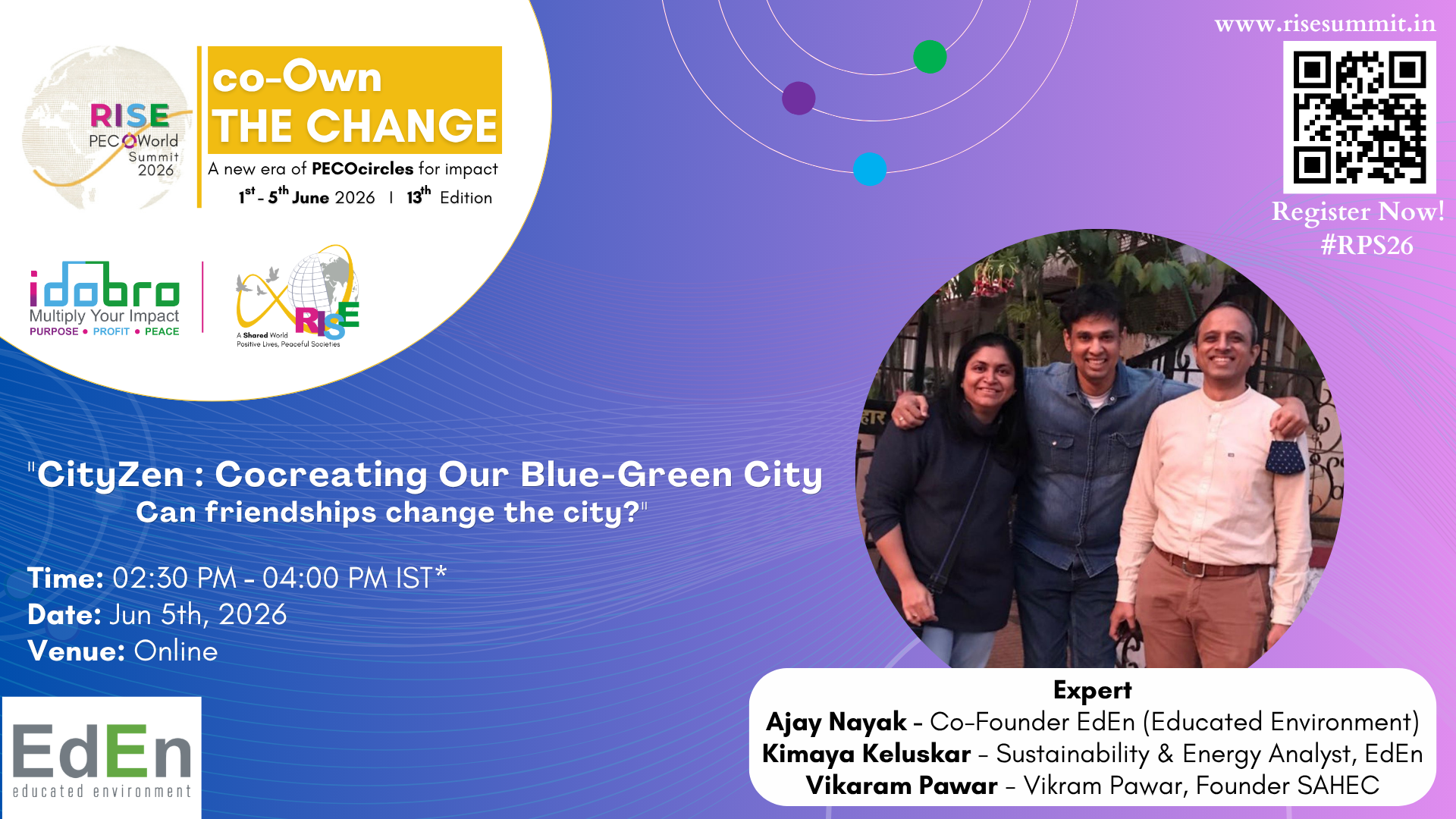
CityZen : Cocreating Our Blue-Green City Can friendships change the city?
Modern concrete jungles have fractured the relationship between human habitats and natural water cycles, driving severe urban flooding and ecological decay. In this session held on 3rd June 2026, panelists Ajay Nayak, Kimaya Keluskar, and Vikram Pawar argue that reversing this crisis requires a transition to "blue-green urbanism"—integrating water systems and ecology directly into city design. The core thesis: urban transformation cannot be achieved through top-down municipal planning alone; it requires shifting to a shared-ownership model powered by localized grassroots networks and structural citizen commitment. Proximity does not equal alignment. Real urban impact requires moving past passive dialogue in community groups and stepping into structured, "skin-in-the-game" execution. In our rush to build vertical, climate-insulated cities, we face a profound infrastructural paradox: we pave over our natural floodplains and concrete our streams, only to express surprise when our streets turn into raging rivers each monsoon. For decades, urban development has treated water management and ecology as secondary engineering problems rather than the foundational landscape of a city. This artificial separation has structural consequences, driving chronic urban flooding, groundwater depletion, and environmental degradation. To move beyond this vulnerability, the panel argued that India must transition from treating citizens as passive municipal consumers to recognizing them as active co-designers of the "Blue-Green City." Restoring Ecosystems: The Architecture of Blue-Green Urbanism Traditional grey infrastructure relies entirely on pipes, concrete drains, and retention walls to fast-track rainwater out of the city—a design philosophy that is rapidly failing under extreme climate events. Blue-green urbanism, as explored by Ajay Nayak (Co-Founder, EdEn) and Kimaya Keluskar (Sustainability & Energy Analyst, EdEn), offers a structural alternative: blending water management (blue) and green spaces (green) directly into the urban fabric. This model shifts the planning paradigm from fighting natural hydrology to working with it. By restoring natural urban watersheds, daylighting choked streams, and implementing permeable green networks, cities can absorb rainfall rather than repel it. Achieving this at scale, however, demands breaking down top-down administrative silos and substituting them with a shared ownership model where local communities actively drive and protect environmental restoration. The Human Infrastructure: Friendship and Radical Collaboration Technical design represents only half the equation; the panel emphasized that the true bottleneck to sustainable urban change is the social infrastructure behind it. Vikram Pawar (Founder, SAHEC) highlighted a foundational truth often ignored in professional spaces: large-scale social movements are anchored and sustained by deep personal relationships. The battle against urban ecological decay is notorious for bureaucratic gridlock and high burnout rates. Within this landscape, personal friendships function as an essential form of "positive peer pressure," providing the emotional resilience and trust needed to navigate institutional hurdles over multi-year timelines. Furthermore, the panel introduced a sharp framework for civic mobilization, cautioning that simply bringing people into the same room or WhatsApp group does not guarantee results. True alignment requires moving beyond superficial talk and establishing clear mechanisms where citizens contribute tangible resources, time, and accountability. The PECO Model: Operationalizing Grassroots Scale To bridge the gap between intent and execution, the session showcased the operational architecture of the PECO World platform. The framework relies on five distinct, interconnected mechanisms designed to turn passive citizens into organized, high-impact networks: 1. Personal Test: Self-Assessment. Evaluating individual behaviors, ecological footprints, and consumption patterns within the context of a wider urban collective. 2. Passport: Defining Alignment. Establishing a formal, transparent record of the specific environmental causes and community actions an individual commits to supporting. 3. Go-To Exchange: Resource Optimization. Operating a localized marketplace for exchanging skills, data, tools, and project opportunities across the ecosystem. 4. PECONet: Network Amplification. Providing digital visibility and structural tracking to scattered, highly effective grassroots initiatives that are often invisible to formal planning. 5. PECO Circles:Project Execution. Forming agile, project-based collaboration cells to rapidly implement targeted blue-green interventions on the ground. Proof of Concept: Radical Communication and Grassroots Action The panel grounded these frameworks in two powerful operational case studies, proving that community-driven models can rapidly bypass traditional structural friction: Nashik’s "Green Kumbh": A massive, citizen-led intervention that united intellectuals, residents, and local municipal administrators. The coalition successfully mobilized thousands of active participants to clean the Godavari river and its vital tributaries, showcasing how mass civic action can align with state machinery. Pandemic Film Communication: During the height of COVID-19 isolation, the team produced and distributed a targeted documentary highlighting the invisible, accelerating urban water crisis in Mumbai. The project demonstrated the power of creative media in translating dry hydrological data into a felt public urgency. Conclusion: Building New Systems The future of sustainable Indian cities cannot be secured by merely retrofitting crumbling, outdated engineering systems. True transformation requires building entirely new paradigms of civic partnership. By stepping out of the role of complaining beneficiaries and organizing as active entrepreneurs and partners, citizens can dissolve bureaucratic gridlock from the bottom up. The session left the summit with a definitive challenge: Are we ready to stop waiting for the city to fix itself, and start co-creating the spaces we inhabit? FAQ What exactly is a "Blue-Green City"? It is an urban planning framework that rejects purely concrete (grey) infrastructure. Instead, it systematically integrates the city's water systems (blue)—like lakes, wetlands, and rivers—with its natural ecosystems (green)—such as parks, forests, and green roofs—to naturally manage stormwater, reduce flooding, and lower temperatures. How does the PECO Model turn casual community discussions into actual projects? It moves citizens through a structured funnel. It starts by assessing individual capacity (Personal Test) and securing a firm dedication to a specific cause (Passport). It then provides the operational tools to swap resources (Go-To Exchange), map networks (PECO Net), and launch dedicated implementation teams (PECO Circles). What was the core takeaway from Nashik’s "Green Kumbh" initiative? It proved that environmental rejuvenation scales when it crosses socioeconomic divides. By creating a unified platform where ordinary citizens, grassroots activists, and municipal bureaucrats worked alongside each other, the initiative transformed a complex river cleanup into a shared civic duty.
Watch again